Project:Helix
A downloadable Project:Helix
PROJECT FELIX
Game Overview
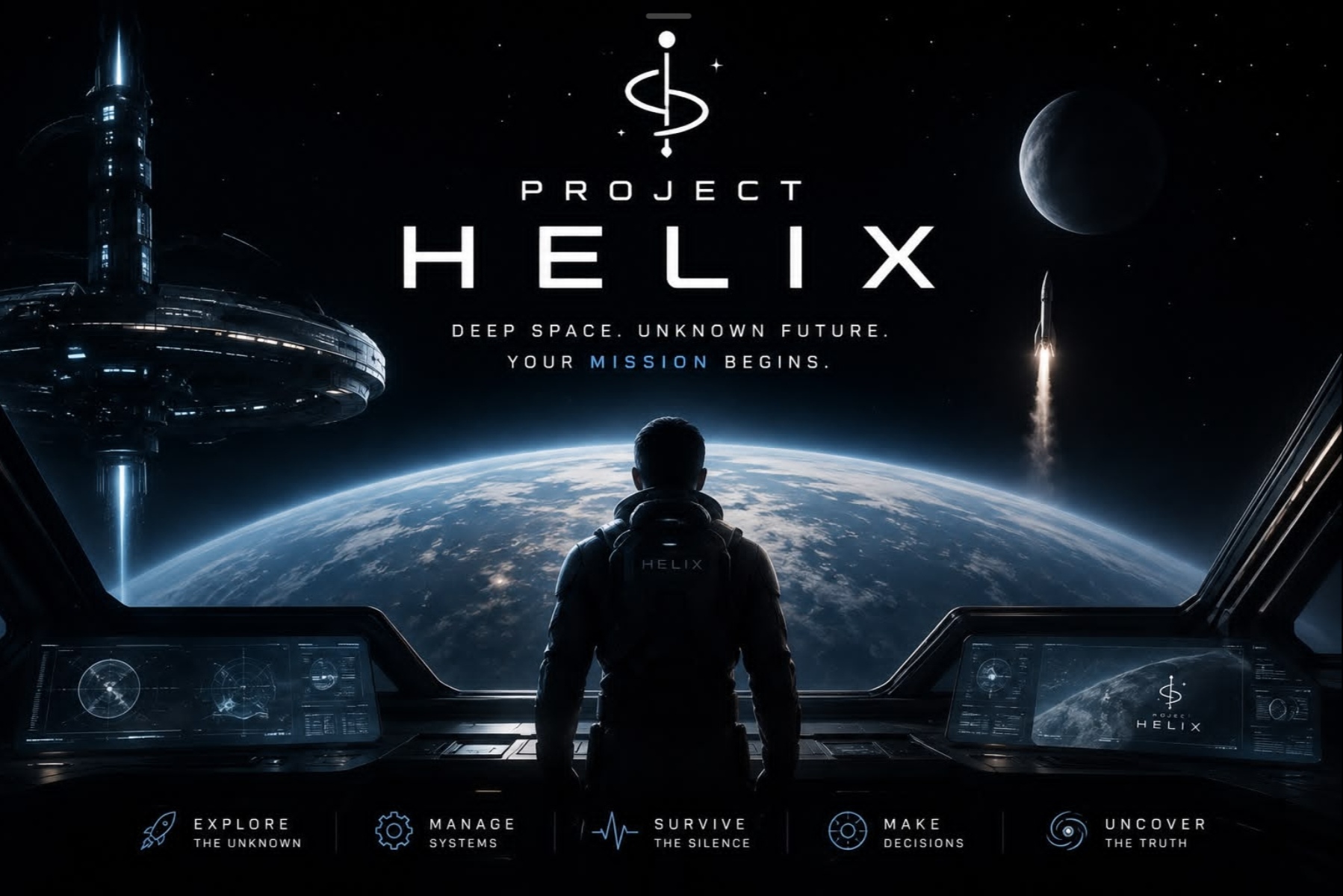
Project Felix is a cinematic space exploration, engineering, and survival game focused on one simple idea:
You are not a superhero. You are a crew member trying to keep a spacecraft alive.
The game begins with the player creating an account and preparing for a space mission. Instead of starting in a menu or immediately spawning on a planet, the player starts inside a launch vehicle, strapped into their seat as the rocket prepares to leave Earth.
The rocket launches, passes through the atmosphere, reaches orbit, and eventually begins its journey into deep space. From this point onward, the player becomes responsible for navigating the spacecraft, monitoring its systems, exploring the ship, and dealing with unexpected problems.
There are no aliens, no weapons, and no traditional combat system. The main challenge comes from the spacecraft itself, the environment, limited resources, navigation, engineering problems, and the consequences of making the wrong decision.
⸻
1. THE BEGINNING
When the player first starts Project Felix, they create their account and their player profile.
After the initial setup, the game immediately places them inside the spacecraft.
The player is sitting in their launch seat inside a futuristic crew capsule. Around them are:
* Control panels
* Screens
* Warning indicators
* Navigation equipment
* Communication systems
* Life-support controls
* Mission information
* Emergency equipment
* Other crew seats
The player can look around the cabin and interact with different objects.
A countdown begins.
T-minus 10 seconds.
The rocket launches.
The player experiences the entire launch sequence from inside the spacecraft. The cabin shakes, the engines become extremely loud, the vehicle accelerates, and the player watches the Earth gradually disappear below them.
The launch should feel like the beginning of a real mission, not a cutscene that the player simply skips.
⸻
2. SPACECRAFT NAVIGATION
After reaching orbit, the player gains control of the spacecraft’s navigation system.
Project Felix should have a large interactive space map.
The map acts like a futuristic navigator.
It displays:
* Earth
* The spacecraft’s current position
* Planned destinations
* Orbital paths
* Waypoints
* Mission objectives
* Other celestial objects
* Unknown areas
* Navigation routes
* Estimated travel times
* Current trajectory
The player can select a destination and create a route.
A navigation line appears on the map, showing the planned path of the spacecraft.
The player then has to follow that route and make corrections when necessary.
The map should feel like a combination of a spacecraft navigation computer and a futuristic GPS.
Instead of simply pressing “Go to Destination,” the player should feel like they are actually navigating a spacecraft.
⸻
3. THE SPACECRAFT
The spacecraft is one of the most important parts of the game.
It should be fully explorable.
The player can walk through different sections of the ship instead of being permanently locked inside the cockpit.
Possible areas include:
Command Cabin
The main control area containing:
* Navigation
* Flight controls
* Communications
* Mission computer
* Main displays
* Camera controls
Crew Quarters
A small living area where the player can:
* Rest
* Access personal equipment
* Check mission information
* Interact with objects
Engineering Section
The technical heart of the spacecraft.
It contains:
* Power systems
* Electrical panels
* Cooling systems
* Engines
* Batteries
* Fuel systems
* Computer hardware
* Circuit panels
Life Support
This system controls the conditions necessary for the crew to survive.
It includes:
* Oxygen
* Temperature
* Pressure
* Air circulation
* Carbon dioxide filtering
Communications
The player can use communication systems to receive:
* Mission updates
* Messages
* Navigation information
* Emergency warnings
* Instructions from mission control
Cargo / Storage
The ship contains equipment and supplies that can be used during missions.
The player should have limited storage space, meaning they cannot simply carry everything.
⸻
4. SYSTEM FAILURES
The main gameplay mechanic of Project Felix is system failure.
The spacecraft is constantly operating through interconnected systems.
Things can go wrong.
For example:
* A power system can fail.
* A navigation computer can malfunction.
* Communications can stop working.
* Oxygen levels can become unstable.
* A cooling system can fail.
* An electrical circuit can overload.
* A sensor can provide incorrect information.
* An engine can develop a problem.
* A section of the spacecraft can lose power.
* A computer can shut down.
* A door can become locked because of a malfunction.
The important part is that failures should not simply produce a notification saying:
SYSTEM FAILURE
Instead, the player should have to figure out what happened.
⸻
5. GETTING OUT OF THE CABIN
One of the game’s signature mechanics is the transition from sitting inside the cockpit to physically exploring the spacecraft.
For example, the player could be peacefully monitoring the mission when suddenly:
WARNING.
The ship experiences a major malfunction.
The lights change.
Alarms activate.
The navigation screen starts showing errors.
The player gets out of their seat.
Instead of controlling a spaceship from a menu, the player now has to physically move through the spacecraft.
They walk into the engineering section.
They inspect the equipment.
They find the problem.
They collect the necessary tool.
They repair the damaged system.
They return to the cockpit.
The ship continues its journey.
This creates a strong gameplay loop:
Navigate → Monitor → Failure → Explore → Diagnose → Repair → Return → Continue Mission
⸻
6. ENGINEERING GAMEPLAY
Project Felix should make engineering an actual gameplay mechanic rather than a simple button press.
When repairing something, the player may need to:
* Inspect components
* Follow cables
* Check circuit breakers
* Restart systems
* Replace damaged components
* Connect equipment
* Adjust settings
* Diagnose errors
* Follow technical instructions
* Monitor system temperatures
* Balance power consumption
Different failures should require different solutions.
A power problem should not be solved the same way as a communication problem.
The player should gradually become familiar with the spacecraft.
As they learn how the ship works, they become better at solving problems.
⸻
7. RESOURCE MANAGEMENT
The spacecraft has limited resources.
The player must monitor things such as:
* Oxygen
* Electricity
* Fuel
* Battery charge
* Water
* Food
* Temperature
* Internal pressure
* Spare parts
Resources should not constantly drain extremely quickly.
The game should give the player enough time to understand what is happening and make decisions.
However, poor decisions can create bigger problems.
For example:
A player might use too much electrical power.
This could drain the batteries.
The batteries becoming low could disable non-essential systems.
That could force the player to prioritize which systems remain active.
One small mistake can therefore create a chain of problems.
⸻
8. REALISTIC FEEL
Project Felix should have a strong sense of realism.
The game does not need to simulate every scientific detail perfectly, but the spacecraft should feel believable.
The player should feel:
* Weight
* Isolation
* Distance
* Limited resources
* Mechanical complexity
* Dependence on technology
* The importance of every system
Space should feel enormous.
The player should be able to look through windows and see stars, planets, moons, and distant objects.
Earth should gradually become smaller as the spacecraft travels farther away.
⸻
9. THE SPACE MAP
The map should be one of the most visually impressive interfaces in the game.
It should display the player’s entire mission route.
For example:
Earth → Orbital Station → Lunar Region → Deep Space → Unknown Destination
The player sees their spacecraft moving along the route.
The navigation system can provide information such as:
* Current coordinates
* Velocity
* Direction
* Distance to destination
* Estimated arrival time
* Fuel requirements
* Navigation warnings
The player can zoom in and out of the map.
They can inspect different locations.
They can set waypoints.
They can change their planned route when necessary.
⸻
10. EXPLORATION
Project Felix should not be completely linear.
During the mission, the player may discover locations that were not part of the original route.
These could include:
* Abandoned spacecraft
* Unusual orbital objects
* Research stations
* Communication beacons
* Unknown signals
* Remote satellites
* Asteroid fields
* Unexplored regions
The player can decide whether to investigate.
However, exploration should have consequences.
Changing course could:
* Consume more fuel
* Increase travel time
* Delay the main mission
* Create new risks
* Reduce available resources
The player therefore has to make decisions instead of simply following a predetermined path.
⸻
11. COMMUNICATION
The spacecraft should have a communication system connecting the player to mission control and other parts of the mission.
Messages can arrive during gameplay.
Some could be normal:
MISSION CONTROL:
“Course correction approved. Continue toward waypoint three.”
Others could be urgent:
MISSION CONTROL:
“Felix, we’re receiving abnormal readings from your power system. Confirm status.”
The player can respond through the communication interface.
Communication can also become unreliable during certain situations.
A damaged antenna could cause:
* Delayed messages
* Static
* Missing information
* Communication loss
This makes communication another system the player must maintain.
⸻
12. MISSION STRUCTURE
The game should contain multiple missions rather than one continuous objective.
Early missions teach the player how the spacecraft works.
For example:
Mission 01
Launch from Earth.
Mission 02
Reach the first orbital waypoint.
Mission 03
Perform navigation corrections.
Mission 04
Repair a minor system failure.
Mission 05
Investigate an unexpected signal.
Mission 06
Travel deeper into space.
Mission 07
Survive a major spacecraft malfunction.
Mission 08
Reach an unknown destination.
Later missions become increasingly difficult.
The player has to use everything they learned earlier.
⸻
13. FAILURE AND CONSEQUENCES
The game should not constantly punish the player.
However, mistakes should matter.
If the player ignores a warning, the problem can become worse.
For example:
Small electrical fault
↓
Player ignores it.
↓
Electrical system becomes unstable.
↓
Multiple systems shut down.
↓
Emergency power activates.
↓
Player must manually repair the system.
This creates tension without needing combat.
⸻
14. NO WEAPONS
Project Felix is not a combat game.
There should be:
* No guns
* No shooting
* No traditional enemies
* No weapon upgrades
* No combat system
The player survives through:
Knowledge + Engineering + Navigation + Decision Making
The spacecraft itself is the challenge.
⸻
15. ATMOSPHERE
The atmosphere should be cinematic and immersive.
Most of the time, space is quiet.
The player hears:
* Electrical equipment
* Fans
* Computer systems
* Mechanical noises
* Distant alarms
* Radio communications
* Footsteps inside the spacecraft
Then something goes wrong.
The silence disappears.
Warning lights activate.
The spacecraft begins making unfamiliar sounds.
The player has to figure out what happened.
This contrast between calm exploration and sudden emergencies should be one of the game’s strongest features.
⸻
16. VISUAL STYLE
Project Felix should have a modern cinematic sci-fi aesthetic.
The spacecraft should look functional rather than excessively futuristic.
The design should contain:
* Metal surfaces
* Screens
* Cables
* Mechanical components
* Control panels
* Warning lights
* Technical labels
* Windows
* Storage compartments
* Realistic spacecraft interiors
The exterior should look like a believable spacecraft designed for long-distance missions.
Space should have detailed stars, planets, asteroids, distant objects, and realistic lighting.
⸻
17. PLAYER PERSPECTIVE
The main gameplay should be experienced from a first-person perspective.
The player sees:
* Their hands
* Tools
* Control panels
* Doors
* Equipment
* The spacecraft interior
When sitting in the cockpit, the player can interact directly with the controls.
When walking around the spacecraft, they can inspect and interact with physical objects.
The goal is to make the player feel like they are inside the spacecraft, not controlling it from outside.
⸻
18. THE CORE GAMEPLAY LOOP
The complete Project Felix gameplay loop should feel like this:
Launch
↓
Navigate
↓
Explore
↓
Monitor the spacecraft
↓
Receive mission information
↓
Something goes wrong
↓
Leave the cockpit
↓
Investigate the spacecraft
↓
Diagnose the problem
↓
Repair the system
↓
Manage resources
↓
Return to navigation
↓
Continue the journey
↓
Discover something new
↓
Make a decision
↓
Continue deeper into space
The further the player travels, the more complex the problems become.
⸻
19. THE MAIN GOAL
The ultimate goal of Project Felix is not simply to “reach the end.”
The player is trying to complete the mission while keeping the spacecraft operational.
Every decision matters.
The player must constantly ask:
Do I continue?
Do I investigate?
Do I change course?
Do I spend the remaining resources?
Do I repair this system now or continue the mission?
What happens if I make the wrong choice?
The game should make the player feel responsible for the spacecraft.
⸻
20. PROJECT FELIX IN ONE SENTENCE
Project Felix is a cinematic first-person space engineering and survival game where you launch from Earth, navigate through deep space, explore your spacecraft, repair complex system failures, manage limited resources, and make critical decisions while trying to complete a mission far from home.
The central philosophy is simple:
No aliens. No armies. No weapons.
Just you, your spacecraft, and the enormous universe outside the window. 🚀


Leave a comment
Log in with itch.io to leave a comment.